Tell us a little about your business and we'll help you determine the right solution.
An EB-5 business plan should clearly communicate your commercial opportunity, investment strategy, business operations, growth potential, and projected job creation in a professional and structured format.
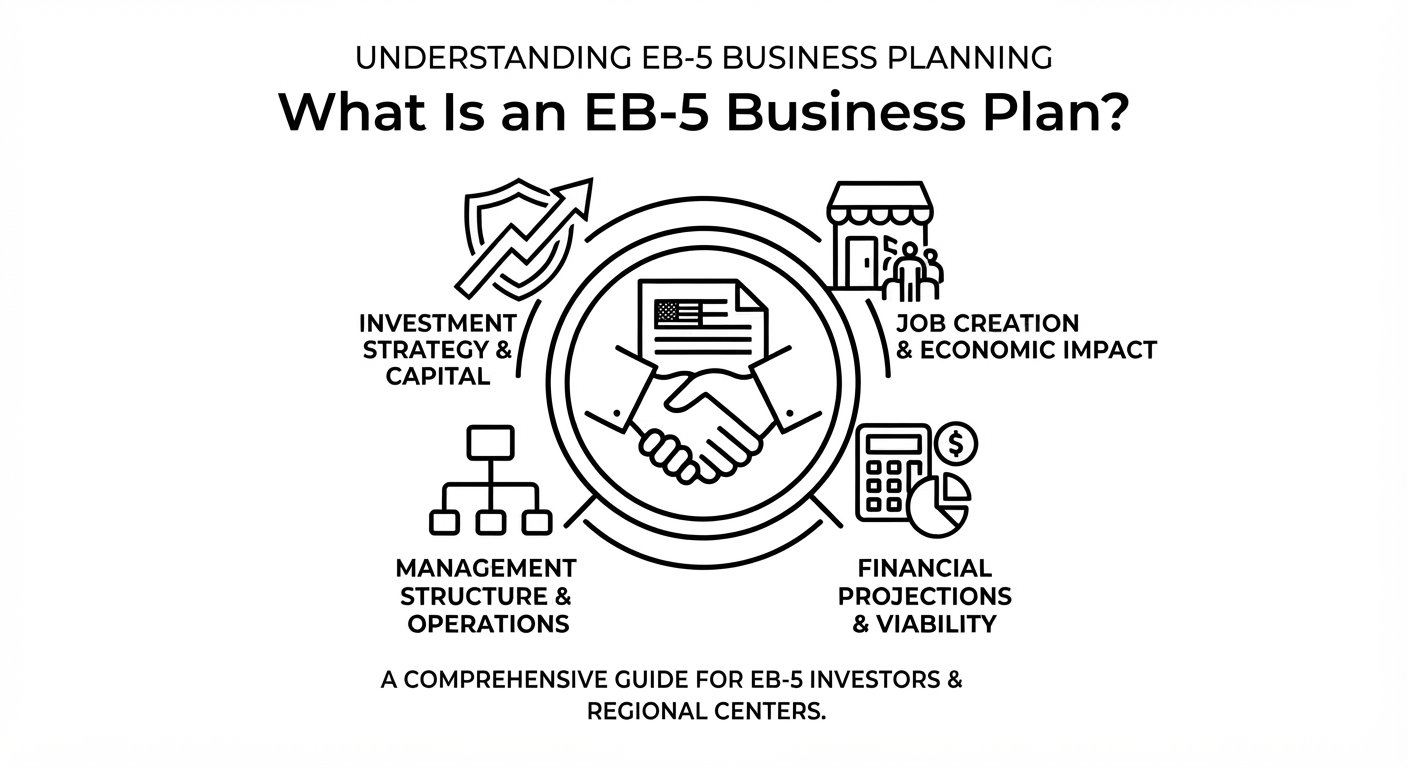
EB-5 Visa Business Plans are designed for foreign investors who plan to invest in or acquire a qualifying commercial enterprise in the United States. The business plan should clearly communicate the proposed enterprise, its market opportunity, operational strategy, financial outlook, and future business development.
An investment project requires more than capital. It needs a clear business strategy that explains how the enterprise will operate, grow, generate revenue, and support its planned workforce.
For an EB-5-focused commercial project, the business strategy should clearly explain how the enterprise plans to operate, expand, and support its staffing requirements over time.
Explain clearly how the commercial enterprise will function on a day-to-day operational level and deliver its primary value proposition.
Outline anticipated roles, hiring schedules, management structure, and long-term workforce development plans.
Demonstrate project development phases from initial setup to full operational capacity over a structured timeline.
Project revenue streams, direct costs, operating expenditure, and financial milestones based on verified inputs.
Support the core business model with localized industry analysis, target customer demographics, and demand drivers.
Identify commercial variables and outline strategic contingency frameworks to support operational resilience.
With multiple investment opportunities competing for attention, the project's marketing and presentation strategy should clearly communicate its value and business opportunity.
Depending on the project, different organizational or regional center structures may be relevant to the overall business strategy.
Investors may carefully evaluate the strengths, risks, operations, and future potential of a project. The strategy must communicate key data points clearly.
Clear communication about the business model, strategy, operations, risks, and financial assumptions helps stakeholders understand project viability.
A well-organized project structure and professional planning process can help communicate the business opportunity more effectively.
Complex commercial projects require coordinated expertise across business planning, market research, financial modeling, and related disciplines.
Tailored for investors seeking direct operational oversight and commercial ownership of a single enterprise.
Designed for large-scale commercial developments pooling capital across broader economic regions.
Financial modeling should be grounded in documented market standards, verifiable operational costs, and sound business economics.
Understand the commercial project and overall business objectives.
Collect details on enterprise structure and investment strategy.
Analyze market opportunity, target demographic, and competitors.
Formulate the operational and growth execution framework.
Develop financial assumptions and dynamic revenue projections.
Draft the full strategic narrative and technical documentation.
Incorporate feedback from client and advisory professionals.
Deliver the finalized, publication-ready strategic business plan.
Complex commercial projects require a clear understanding of the business model, market opportunity, operations, financial outlook, and long-term strategy.
Organize complex operational and investment data into a clear, compelling business narrative.
Present commercial opportunities professionally to align stakeholders and advisors.
Anchor commercial planning in empirical market research and competitive data.
Build rigorous, multi-year mathematical models grounded in documented assumptions.
Speak directly with a Senior Business Analyst. Get a complete quote and free initial review of your project.

.png)